I was interviewed by Hadassah Egbedi, for Okay Africa after she had heard about my residency and talk at Angels and Muse. You can read more about it below.
https://www.okayafrica.com/vehicle-art-of-west-africas/
The Enduring Vehicle Art of West Africa’s Bustling Streets
Even as trucks and buses give way to more compact tricycles, the messages and motifs that are inscribed on different modes of transportation keep them an essential part of local storytelling.
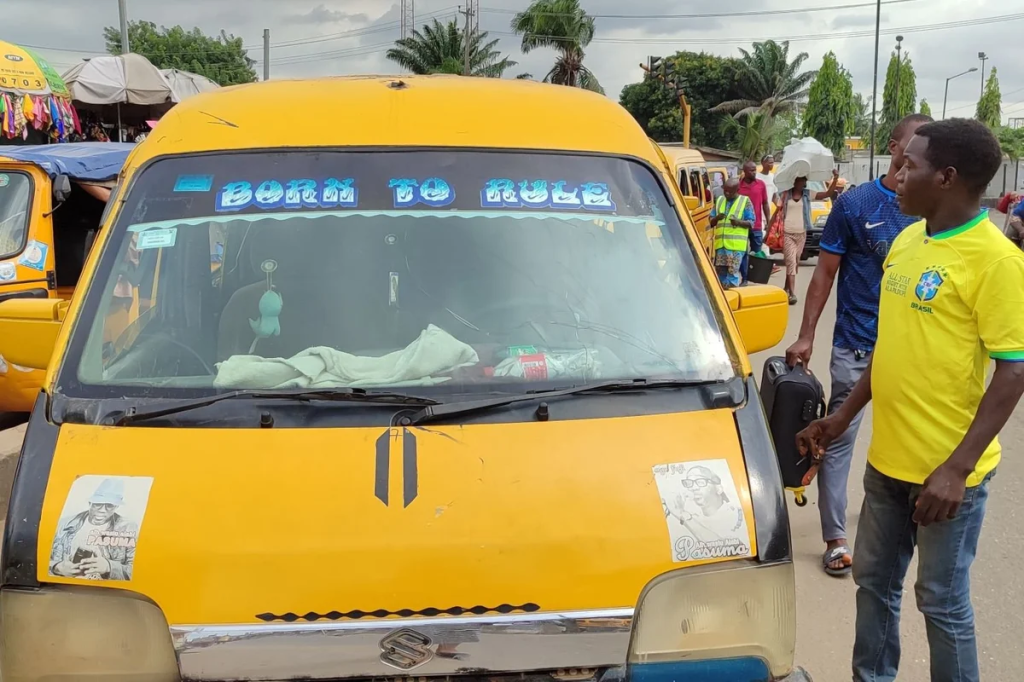
The danfo (bus) in front of me is in a hurry. So much so that it almost hits a pedestrian squeezing his way between it and the vehicle preceding it. Offended, the man pauses to berate the driver briefly before continuing on his way. This scene is typical of rush hour in Lagos. Hand-painted on the side of the offending bus, amongst other decorative motifs, are clasped hands. There is no accompanying text, so it’s open to interpretation. It could be a prayer or thanksgiving – “God, bless my hustle,” or “Thank you, Jesus.” This, too, is typical of Lagos.
Across Nigerian and West African cities, painted buses, trucks, and tricycles catch the eye. Bright colors, patterns and sayings cover these vehicles, making them into mobile galleries of public art. However, these artworks are not merely decorative; they serve as a mirror or expression of the local culture and identity. “Vehicular art is a strong, obvious identity among West Africans,” says acclaimed artist and founder of Angels and Muse Residency, Victor Ehikhamenor. “Whenever you see a truck or vehicle with art and inscriptions transporting people or cargo, you automatically know it’s from West Africa.”
The tradition of vehicle art in West Africa has a multifaceted origin. While its roots can be traced back to the colonial era when colonists first imported vehicles, art researcher Ife Adegbie focuses on its vibrant post-colonial development. As car ownership became widespread in the 1970s, a unique phenomenon unfolded. “Vehicle owners began personalizing their cars by naming them and painting route information on the back windshields,” Adegbie explains. “This practice quickly evolved, with owners developing distinct visual identities.”
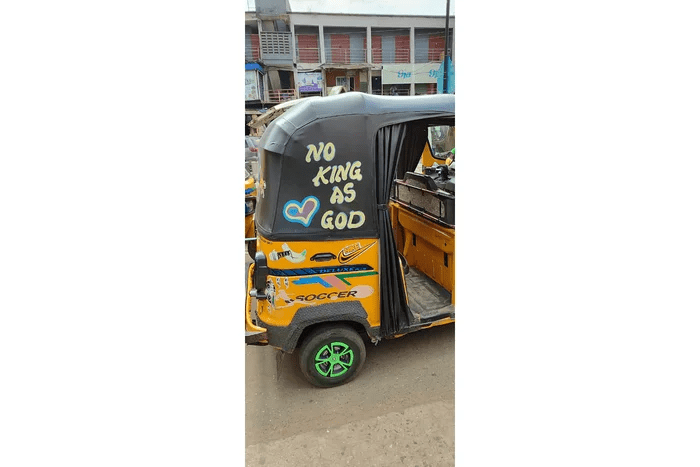
In response, traditional signage artists who had long been creating hand-painted signs for businesses and public spaces adapted their skills to meet the new demand. Gbenga Samuel, a Lagos-based signage artist, never set out to do vehicle art. “As an artist, people bring vehicles for us to design, and we must do it,” he tells OkayAfrica. In recent times, the canvas has evolved too — from trucks and minibusses to keke napep (tricycles). And where Samuel once worked primarily with brushes and stencils, vinyl stickers now dominate. “Although the new techniques are faster,” he notes, “hand-painted designs last longer and command more attention.”
Interestingly, vehicle art themes are similar across Nigeria and West Africa, reflecting shared cultural experiences while revealing personal narratives. Religious iconography — Mary and baby Jesus, the Last Supper, and the Garden of Eden – feature prominently on cargo trucks. Commercial buses opt for simpler designs, favoring religious expressions and local sayings like “The Lord is My Shepherd” and “Surulere (slow down).””If there’s an ongoing trend or slogan like ‘Soro Soke (speak up),’ most drivers want that inscribed on their vehicles,” Samuel explains. Some expressions transcend borders — Adegbie has seen “Fear Who No Fear Woman” on vehicles across Nigeria, Senegal and Ghana. Pop culture finds its place too, with stickers of icons like Davido, Wizkid and Cristiano Ronaldo adorning many vehicles.
 Danfo Yellow
Leave a comment